Media Contact: Georgia Seltzer, (202) 822-8200 x104, gseltzer@vpc.org
Campaign Research Notes – May 5, 2026
If it’s April, then it must be time for the National Rifle Association’s Annual Meetings & Exhibits. Or as the new post-scandal NRA 2.0 (as the group has taken to calling itself) characterizes the conference, “The gala event of the year.”
Each year the meeting is held in a hot, pro-gun state. This year it was held in Houston, Texas — with Atlanta and Orlando up next.
Two events define the meeting. The industry show of new guns (“more than 14 acres of the latest guns and gear”) that is, in fact, the actual centerpiece of the event (more on that in the next update) and the Saturday morning Annual Meeting of Members (the focus of this update).
And for the participants in the Annual Meeting of Members, things were not what they used to be.
Inspiring videos? Gone! Podium-thumping calls to action. Gone! Gratuitous name-calling of perceived enemies of the Second Amendment? Well, some things never change. Instead, the centerpiece was a dry PowerPoint presentation detailing the group’s “Year of Transformation” in the long wake of the scandal-ridden reign of former NRA Executive Vice President (EVP) Wayne LaPierre. Among the accomplishments presented to the, as always, sparse group of participants were fewer direct mail fundraising letters (“Reduced by 64%”), new outside contractors, lots of social media, general belt tightening, and accountability, accountability, accountability!
Talk about argument by assertion.
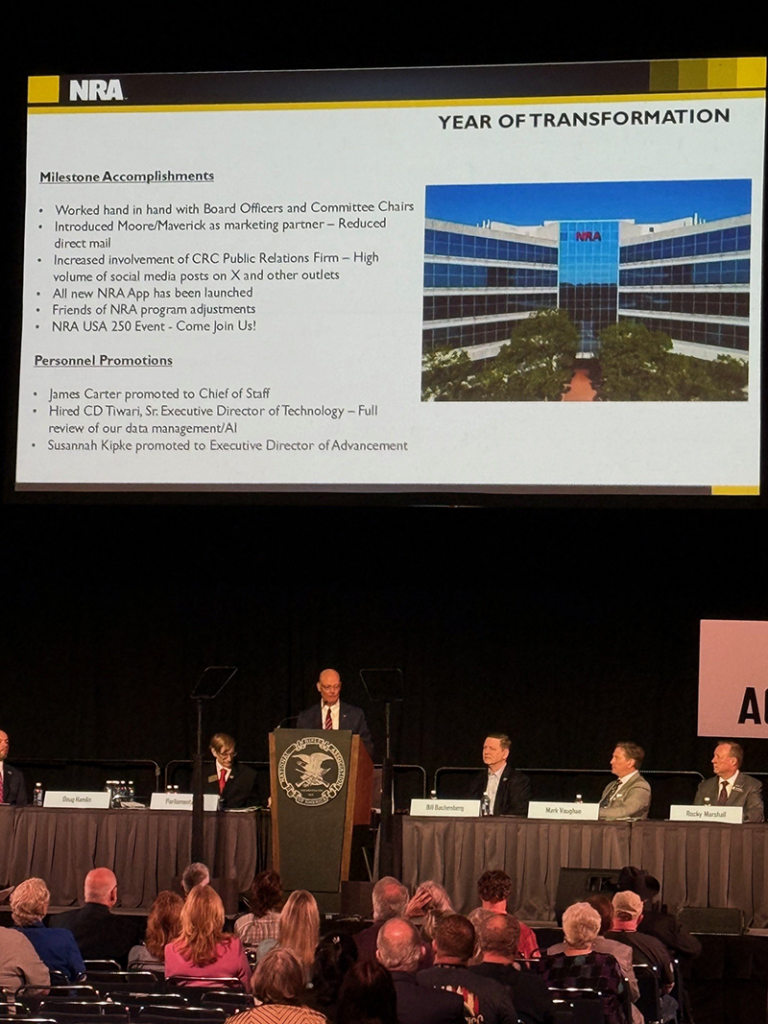
But for the most part, the workmanlike presentations offered by NRA senior staff offered a corporate version of Richard M. Nixon’s infamous “I am not a crook” assertion.
The change in theme voiced by the NRA’s leadership from Second Amendment warriors to responsible bean counters is worth noting — and not without risk. For nearly 50 years NRA 1.0’s style of leadership was a top-down command and control structure requiring a “charismatic” leader (some times more so than others) at the top to inspire and lead the political troops to battle.
The archetype for this was Harlon Carter, one of the leaders of what is known in NRA lore as “The Cincinnati Revolt” which occurred in 1977. During this infamous annual meeting, the group’s then-leadership, known as the Old Guard (who were accused of the sin of focusing more on hunting and the shooting sports as opposed to politics) was ousted by the New Guard, who believed battling gun control measures should be the organization’s primary focus. Looking like a bullet in human form, Carter led the NRA as executive vice president until 1985.
[During his tenure, it was revealed that in 1931 in Laredo, Texas a 17-year-old Carter (already an NRA member) killed 15-year-old Ramón Casiano with a shotgun, after he attempted to force the Latino youth to go with him to talk with Carter’s mother following the theft of the family’s car three weeks earlier. Carter’s conviction was later overturned on appeal on a technicality. Five years after the shooting, Carter joined the U.S. Border Patrol where, as some of his enemies snidely noted years later, he could now shoot Mexicans legally.]
Subsequent EVPs were expected to fill Carter’s gumboots, but none ever succeeded. Each did, however, share a common trait of leaving the organization following reports of scandal. Wayne LaPierre being only the most recent.
So, who’s the latest NRA EVP?
Doug Hamlin, who prior to his ascension to the NRA’s Iron Throne was the organization’s… head of publications. So, not a historically impressive pick. According to a profile in NRA Family, apparently Hamlin’s most notable trait is that he likes to be called by his first name. As a side note, one of Hamlin’s more recent actions was to unceremoniously end the publication of America’s 1st Freedom (the group’s monthly activist magazine) as well as Shooting Illustrated. Its two remaining “legacy” magazines, American Rifleman and American Hunter, were switched to monthly digital release with only quarterly print editions.
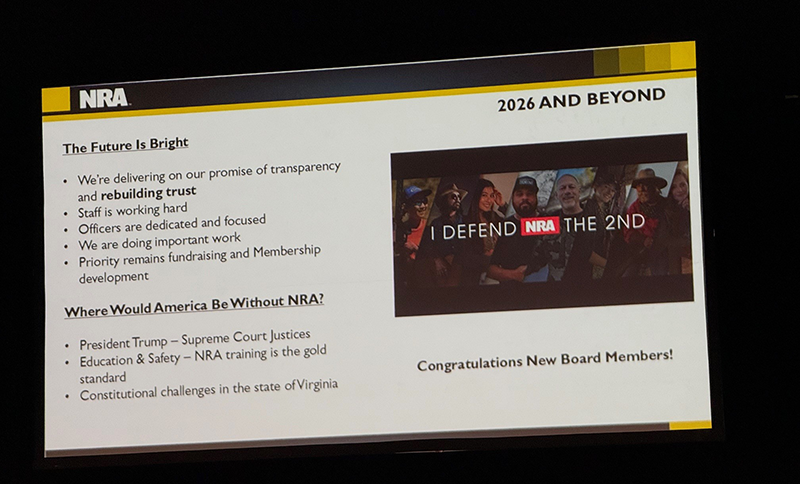
Hamlin’s PowerPoint promised the audience, “The Future Is Bright.” Yet in a measure of what counts as bright in the NRA’s murky universe, the bullet points listed as proof of NRA 2.0’s comeback successes included:
- Staff is working hard
- Officers are dedicated and focused
- We are doing important work
Not exactly a high bar.
Also at the meeting, an amendment to the NRA’s bylaws was proposed that would reorganize and reduce the board’s executive committee to only nine voting members: NRA president; first and second vice presidents; the chairs of the finance, audit, legal affairs, and membership committees; plus two additional members elected by the larger NRA board. The executive committee would be empowered to exercise all the powers of the larger board subject to a list of exceptions.
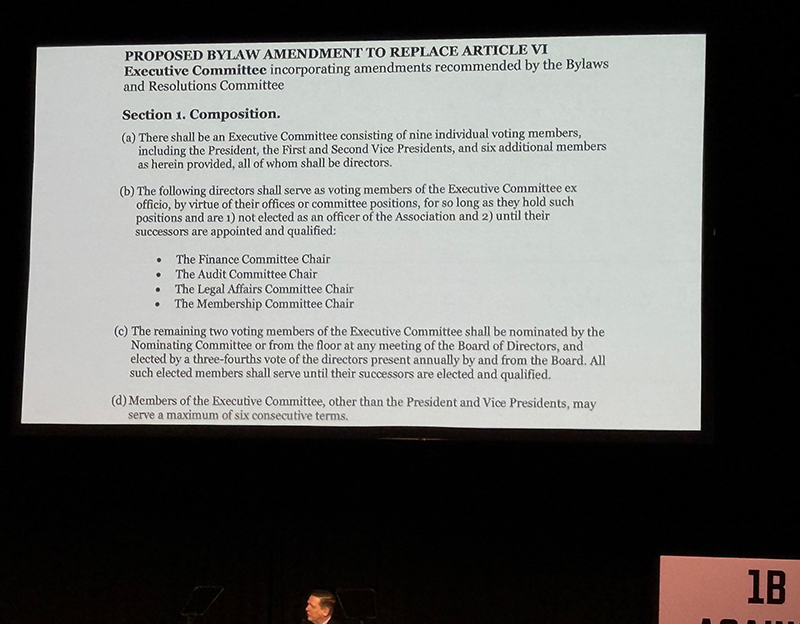
The downsized and revamped executive committee was pitched as being necessary to efficiently handle the group’s day-to-day business, since it could meet (including virtual meetings) in between the thrice-yearly meetings of the full 76-member board.
Response to the proposal from meeting members was mixed. Most members seemed to support the idea in theory. Yet the lessons of the LaPierre era lingered, with others voicing concerns that executive committee 2.0 would place too much power in too few hands.
Ultimately, the bylaws amendment was passed by meeting members and was later approved at the subsequent meeting of the full board with minor changes (adding two additional members, resulting in a now 11-member board).
Apparently old fears die hard.
***
The Violence Policy Center is a national educational organization working to stop gun death and injury. Follow the VPC on X/Twitter, Facebook, Instagram, and BlueSky.