Pennsylvania’s Hidden Gun Manufacturers
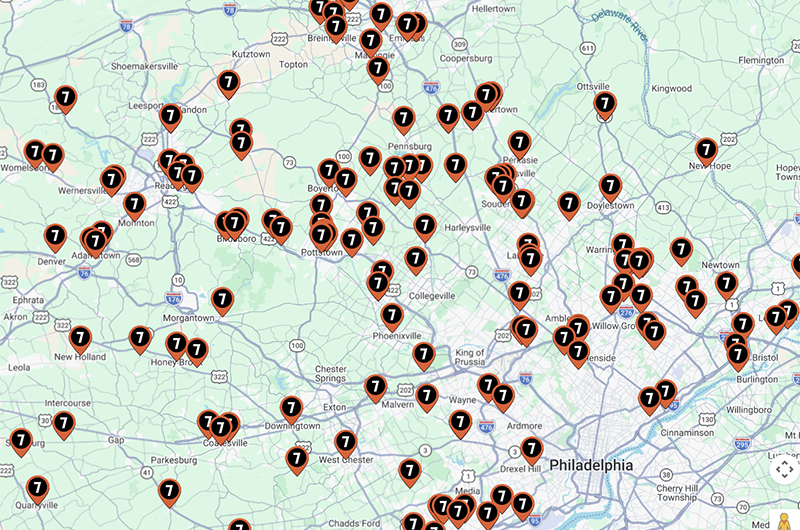
America is awash in gun manufacturers – yet few actually manufacture any guns.
According to the Bureau of Alcohol, Tobacco, Firearms and Explosives (ATF), the government agency charged with enforcing our nation’s federal gun laws, in 1975 the agency issued only 364 Type 07 Federal Firearms Licenses (FFLs), the basic federal license required to manufacture guns in America. By 2024, this number had soared to 20,566 ─ an increase of more than 5,550 percent.1
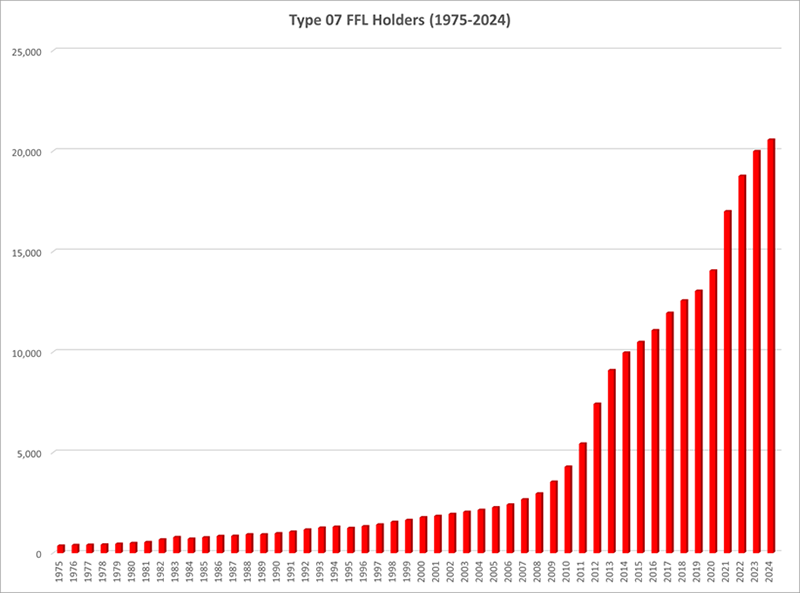
However, the majority of the “gun manufacturers” who possess the Type 07 license do not manufacture firearms in the commonly understood sense. Instead of a commercial manufacturing facility, they operate out of their homes, offices, or unrelated businesses ─ with a significant portion of license holders never even reporting the production of a gun to ATF.
For example, nationally in 2023,2 according to data contained in ATF’s Annual Firearms Manufacturers and Export Report (AFMER)3and Federal Firearms Listings:4
- Eighty-one percent (16,236 of 19,997) of Type 07 license holders did not report producing any guns that year.
- Of the Type 07 license holders who did report producing guns that year, 54 percent (2,028 of 3,761) reported producing 10 or fewer firearms.
- Combined, Type 07 license holders who did not report producing any guns and Type 07 license holders who reported producing 10 guns or fewer that year represented 91 percent of all Type 07 license holders.
In Pennsylvania in 2023,5 according to data contained in ATF’s Annual Firearms Manufacturers and Export Report (AFMER)6 and Federal Firearms Listings:7
- Eighty-two percent (603 of 732) of Pennsylvania Type 07 license holders did not report producing any guns that year.
- Of the Type 07 license holders who did report producing guns that year, 50 percent (65 of 129) produced 10 or fewer firearms.
- Combined, Type 07 license holders who did not report producing any guns and Type 07 license holders who produced 10 guns or fewer that year represented 91 percent of all Type 07 license holders.
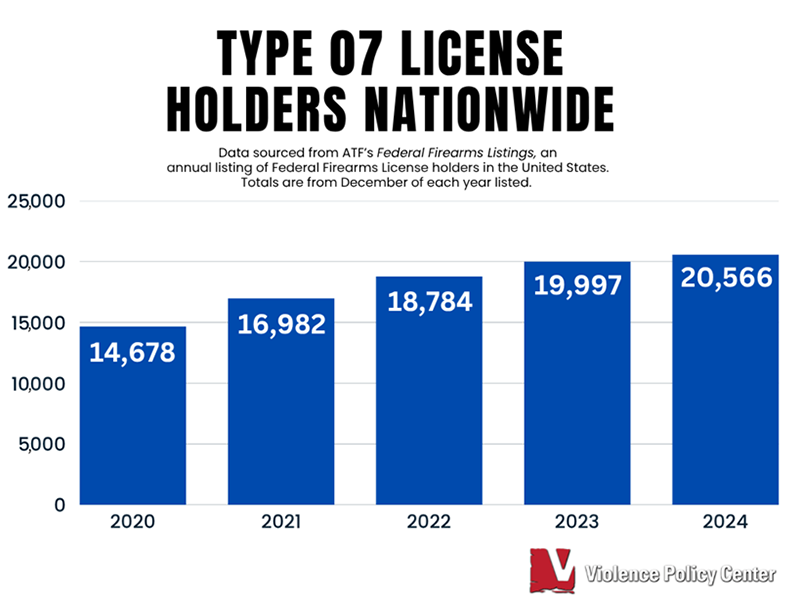
Nationwide, in just the five-year period from 2020 to 2024, the number of Type 07 FFLs increased by 40 percent ─ from 14,678 to 20,566 license holders.8
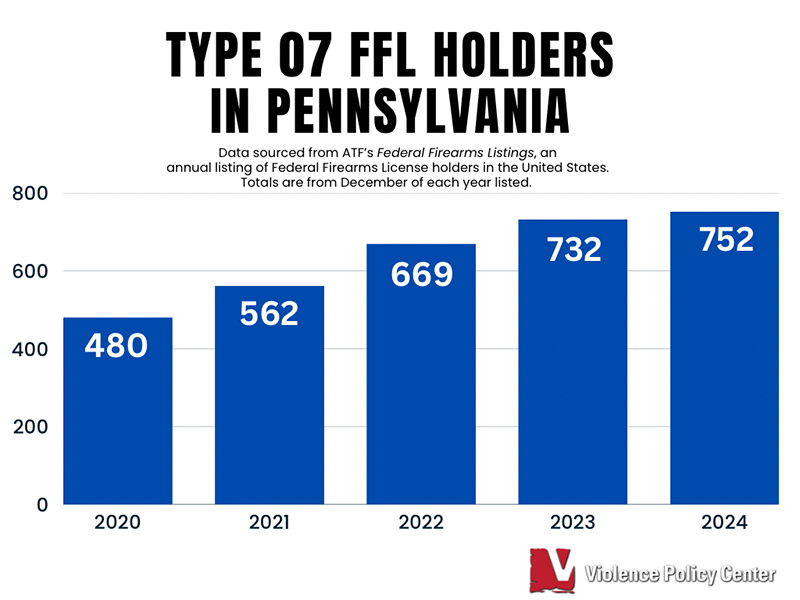
In Pennsylvania for this same period, the number of Type 07 FFL holders increased by 57 percent ─ from 480 to 752 license holders.9
So, if a significant number of these license holders aren’t manufacturing guns, what are they doing? The honest answer is that no one really knows. But if history is any guide, most likely a significant portion are being used by license holders to evade a range of firearm regulations that apply to unlicensed private citizens.10
The Appeal of the Type 07 FFL
The Gun Control Act of 1968 (GCA) established the current federal licensing system for manufacturers, importers, wholesalers, and dealers of firearms. Under the GCA, any person “engaged in the business”11 of making or selling firearms must be licensed by ATF.12
The ATF graphic below describes the nine types of Federal Firearms Licenses (FFLs) issued by the agency.
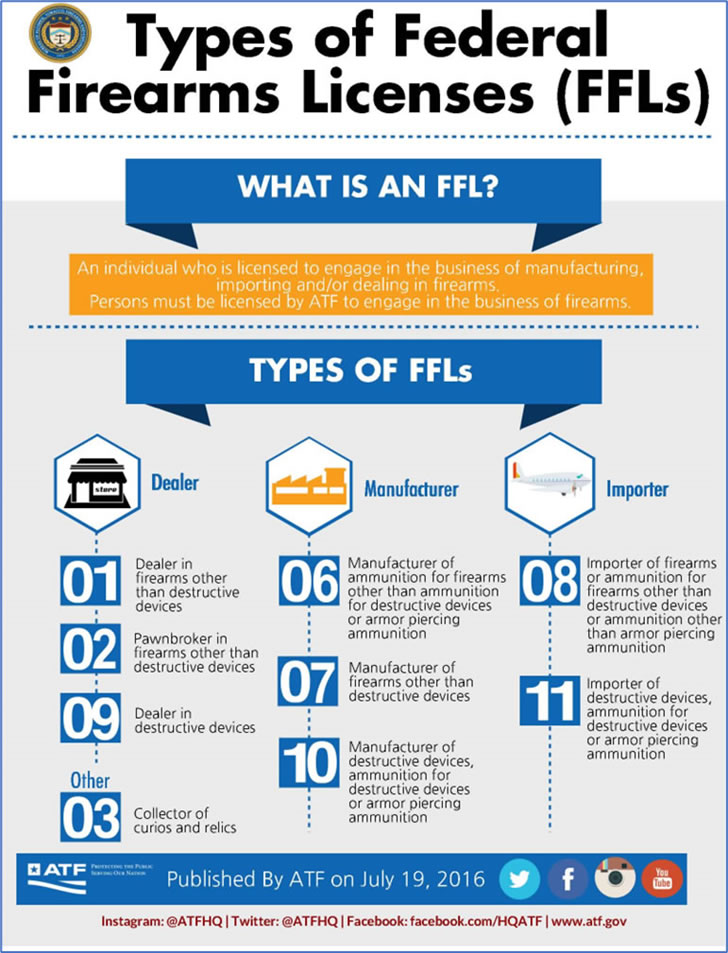
Both the Type 01 FFL dealer’s license (the basic license to sell firearms other than destructive
devices13) and the Type 07 FFL manufacturer’s license (the basic license to manufacture firearms other than destructive devices) exempt the license holder from many of the restrictions on the sale and transfer of firearms that private citizens are subject to under the Gun Control Act. Unlike ordinary citizens, these license holders can:
- buy and sell firearms in interstate commerce and receive firearms via common carrier;
- purchase firearms from wholesalers at discount and in unlimited quantities; and,
- bypass requirements that apply to unlicensed individuals, such as background checks.
In addition, by paying an annual “Special Occupancy Tax” (SOT) a Type 07 license holder, in addition to manufacturing standard firearms, can also manufacture weapons and firearm accessories that come under the more restrictive regulations of the National Firearms Act of 1934 (NFA), such as fully automatic machine guns and firearm silencers.

According to the “federal firearms license experts” at FFL123,14 a commercial site that sells online kits that cater to private citizens who want to obtain an FFL:
The Type 07 FFL is the most powerful and popular FFL to get. With it you can do everything a Type 01 FFL can (buy, sell and repair firearms) plus manufacture guns and ammo. When you add a… SOT to this license you can also make NFA items like silencers and even machine guns!15
The fee for a Type 07 FFL is $150 to apply and $150 to renew every three years. The annual fee for the Type 02 Special Occupancy Tax (SOT) is $1,000 per year.16
FFL123 also promotes the Type 07 license with an SOT as a way for the license holder to undercut the 1986 ban on the private possession of new machine guns. In May 1986, Congress banned the production of new machine guns for civilian sale (private citizens can, however, purchase pre-1986 machine guns under federal law if they meet the heightened sale and possession standards of the NFA as well as state and local laws). The Type 07 license (like the Type 01 license) combined with the SOT allows the possessor access to new, post-1986 machine gun “samples,” ostensibly for law enforcement or similar sales or review.17
As FFL123 trumpets, “In fact, this is the most common way to gain access to post May 1986 machine guns and combine business with pleasure!”18
However, with the Type 07 license, the license holder can also build their own machine gun for what can be, in reality, personal use. In a July 2021 blog titled “Who Can Own a Full-Auto Machine Gun?,” FFL123 owner Brandon Maddox ─ noting, “You might think that this sounds shady, but it’s not” ─ enthusiastically answers his own question as seen in the extended quote below:
Who can own a full-auto machine gun? Well, the simple answer is: you! You can own a machine gun. Yes, that’s right. It’s perfectly legal for you to own a machine gun! They are not some mythical object made up of Unobtainium…
Under current law, only government agencies can acquire newly-made machine guns – but they still need dealers to buy them from and manufacturers to make them.
Sales of such guns go through FFL gun dealers with either an 03 SOT (retail sales of NFA items with an 01 or 02 FFL) or an 02 SOT (manufacturing of NFA items with an 07 or 10 FFL).
Here’s where it gets interesting…
An 03 SOT needs a letter from a law enforcement agency asking to see a particular machine gun demonstrated. This is called a demo letter, and the gun is called a dealer sample. Only 02 and 03 SOTs can acquire dealer samples, and only with a demo letter. Once you allow the agency to examine the gun, it is yours to keep as long as you maintain your SOT. Many SOT holders acquire demo guns from friendly local law enforcement requests.
However, if you cannot get a demo letter, an 03 SOT gun dealer has no other way of acquiring a machine gun. If you are an 02 SOT, though, you are legally allowed to build as many machine guns or other NFA devices as you wish (following a certain procedure, of course) and may retain them for as long as you maintain your SOT.
That’s right: you can build a machine gun (full-auto machine gun) legally and keep it for as long as you wish and are in business!
Too Good to Be True?
You might think that this sounds shady, but it’s not. As long as you are conducting legal business, there are all sorts of reasons to build legal machine guns, including proof of concept, experimentation, range rentals, demo guns, movie prop rentals, and more. Along the way, as an incidental to doing business, there is absolutely nothing wrong with enjoying the machine guns you have built or acquired. In fact, it would be stupid not to do so!19
FFL123 also notes that “ATF inspectors can only come to inspect during ‘business hours.’ They can only inspect once every 12 months. Do not expect an inspection but once every 20 years, as we understand that is their average.”20
This is not an exaggeration. For fiscal year 2024, only eight percent of FFL holders (9,696 out of 127,784) were subject to ATF firearm compliance inspections.21 These 9,696 compliance inspections resulted in recommendations that included: report of violations, 1,689; warning letter, 721; warning conference, 214; license surrendered/out of business, 1,488; revocations, 195. No violations were reported for 5,207 license holders.22
By 2026, this already low percentage of ATF compliance inspections (eight percent) will likely drop even further. According to the Department of Justice’s budget summary, 541 of ATF’s Industry Operations Investigators (IOIs) ─ the personnel responsible for carrying out these inspections ─ are slated to be eliminated by fiscal year 2026. In the budget summary, ATF explains that this will result in a reduction of “ATF’s capacity to regulate the firearms and explosives industries by approximately 40 percent in FY 2026.”23 In fact, this may be an underestimate. In March 2025, ATF reported that there were 857 Industry Operations Investigators; eliminating 541 of them would be a reduction of nearly two-thirds.24
With federal oversight significantly diminished, any regulatory effort will have to be at the local or state levels. This includes any and all zoning laws, business licensing requirements, related fees, and regulations.
The stark reality is that in states across America ─ including Pennsylvania ─ an unknown number of communities are home to “kitchen table” gun manufacturers that are mostly hidden from public view, as the information contained in the next section vividly illustrates.
The Gun Manufacturer Next Door
For this study, the VPC conducted a series of analyses of Pennsylvania’s 732 Type 07 license holders in 2023. As part of this process, the VPC identified Pennsylvania gun manufacturers who reported producing no guns that year or who reported producing fewer than 10 guns that year. While only a snapshot for a specific period in time, the data offers a window into the prevalence of Type 07 license holders in residential areas in the state. As of April 2026, ATF’s list of FFL license holders still lists the pictured structures shown in this report as the license holder’s place of business.
The review revealed that while the majority of FFL holders’ business premises appear to be non-residential structures, a not insignificant portion appear to operate out of homes, in a residential neighborhood, with no easily discerned signage. It seems highly unlikely that the presence of the manufacturer would be known by local residents or passersby from sight alone. Other sites include unrelated commercial entities.
The hidden nature of these gun manufacturers is all the more important keeping in mind the unique privileges granted the Type 07 license holder as detailed throughout this report.
The silent majority: zero reporting manufacturers
In 2023, 82 percent of Pennsylvania’s Type 07 FFL holders (603 of 732) reported no firearm manufacturing activity. While they appear on the Federal Firearms Listings, they are absent from the AFMER. As part of its research on the illegitimate possession of Type 07 FFLs, the Violence Policy Center developed an online tool that allows the user to enter their home (or any) address to see if there are any Type 07 federally licensed gun manufacturers near them. The tool employs Google Earth to allow the user to see a photograph of any structures located at the address of the license holder’s business premises. (The tool also allows the user to search for Type 01 gun dealer license holders.) The tool can also be used to identify license holders by state or zip code.
Using this tool, the VPC examined the publicly listed business premise addresses of all 603 non-reporting license holders. From this survey, it appeared that 40 percent (242 of 603) claimed a residential property as their place of business.
The photos below offer a sample of zero-reporting manufacturers where it appears that they are listing a residential structure as their place of business.
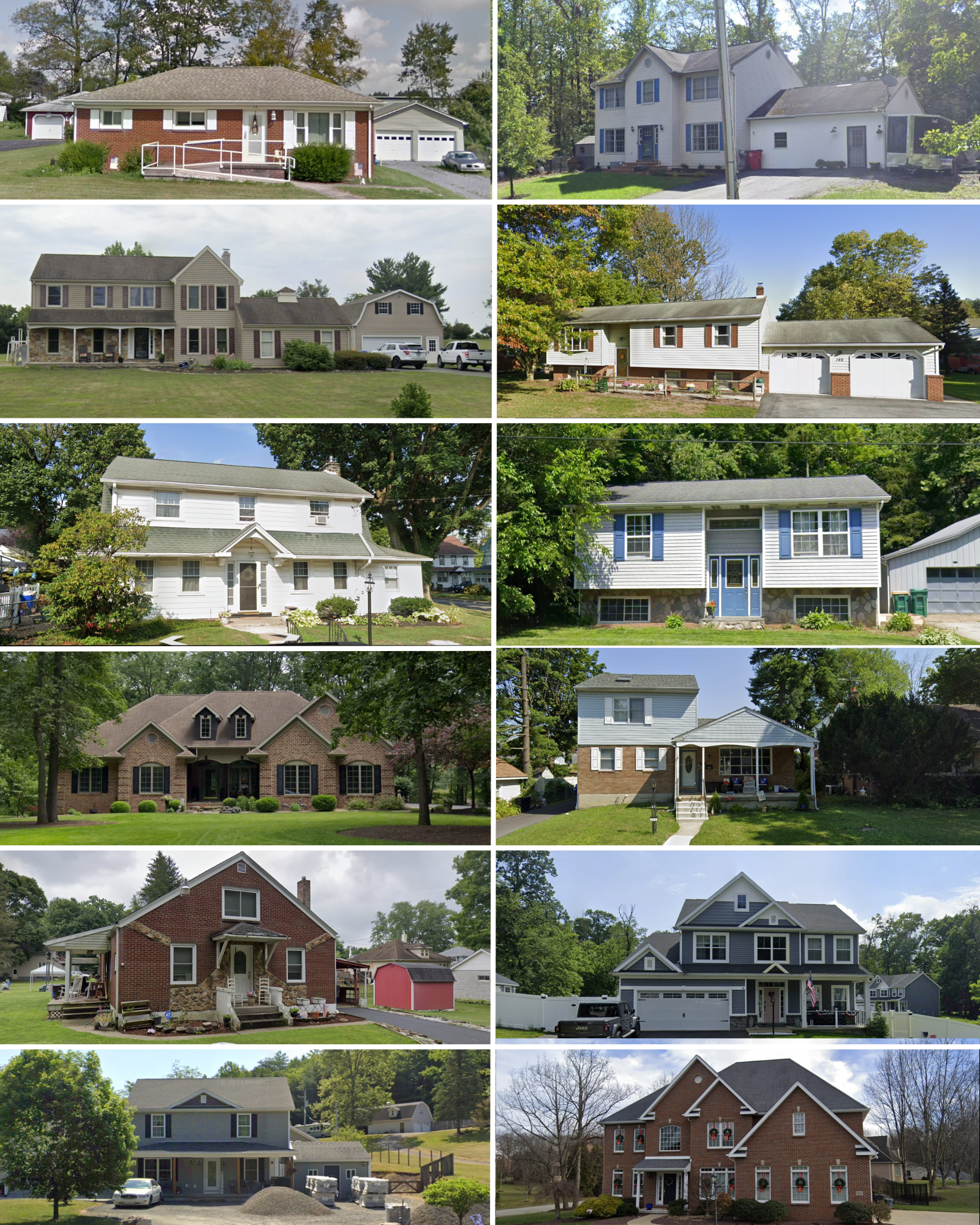
Home-based manufacturers in Pennsylvania
In 2023, the VPC found that only 18 percent (129 of 732) of Type 07 license holders in Pennsylvania reported manufacturing any guns that year. Of the license holders who did manufacture guns, 65 of the 129 (50.3 percent) manufactured 10 guns or fewer.
For this group of 65, using the VPC’s online tool, we researched each license holder’s publicly available address as listed by ATF to identify the structure associated with the license holder’s business premises. We found that 45 percent (29 of 65) appeared to be operating out of a residential structure.
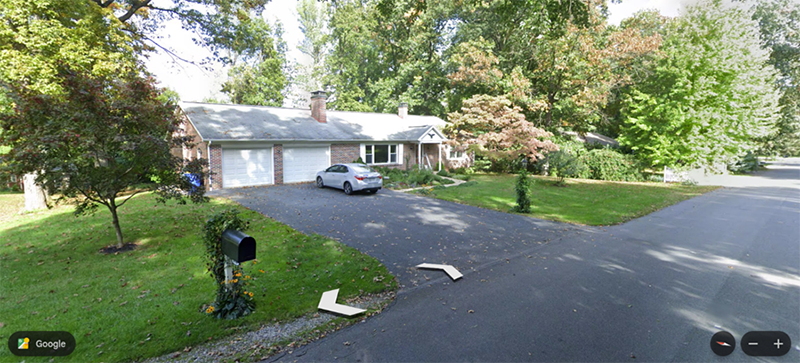
Below is the business premises for M & B CUSTOM FIREARMS INC, which manufactured three rifles in 2023 and is located in Etters, Pennsylvania.
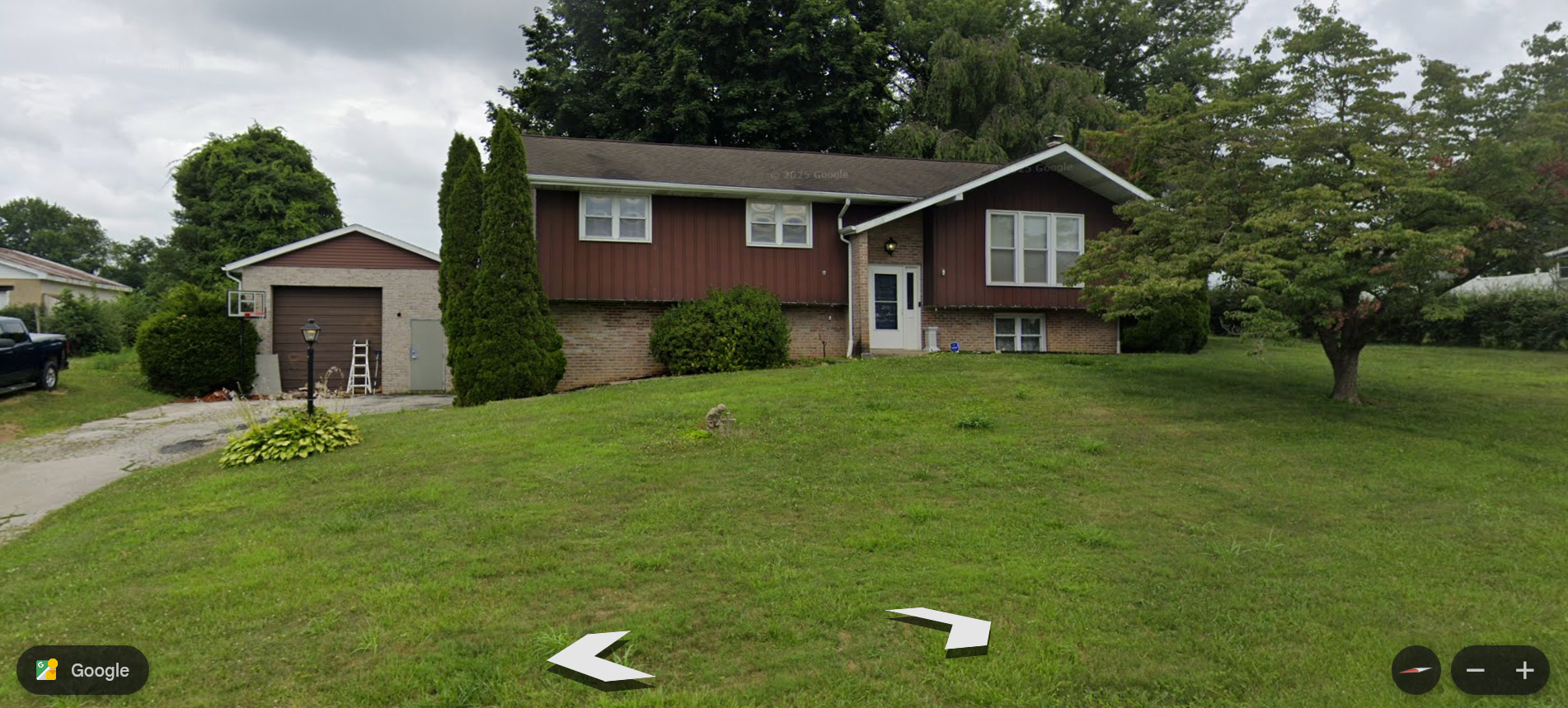
Below is the business premises for BROWNS2A LLC, which manufactured two pistols and two rifles in 2023 and is located in Spring Grove, Pennsylvania.
The slideshow below shows the business premises for Pennsylvania Type 07 license holders who manufactured 10 or fewer firearms and appear to operate out of a residential structure.
More than 10 firearms
In addition, when looking at Type 07 FFL holders who manufactured more than 10 firearms, 23 percent (15 of 64) appeared to be operating out of a residential structure.
The photos below offer a sample of manufacturers who reported producing more than 10 guns where it appears that they are listing a residential structure as their place of business.
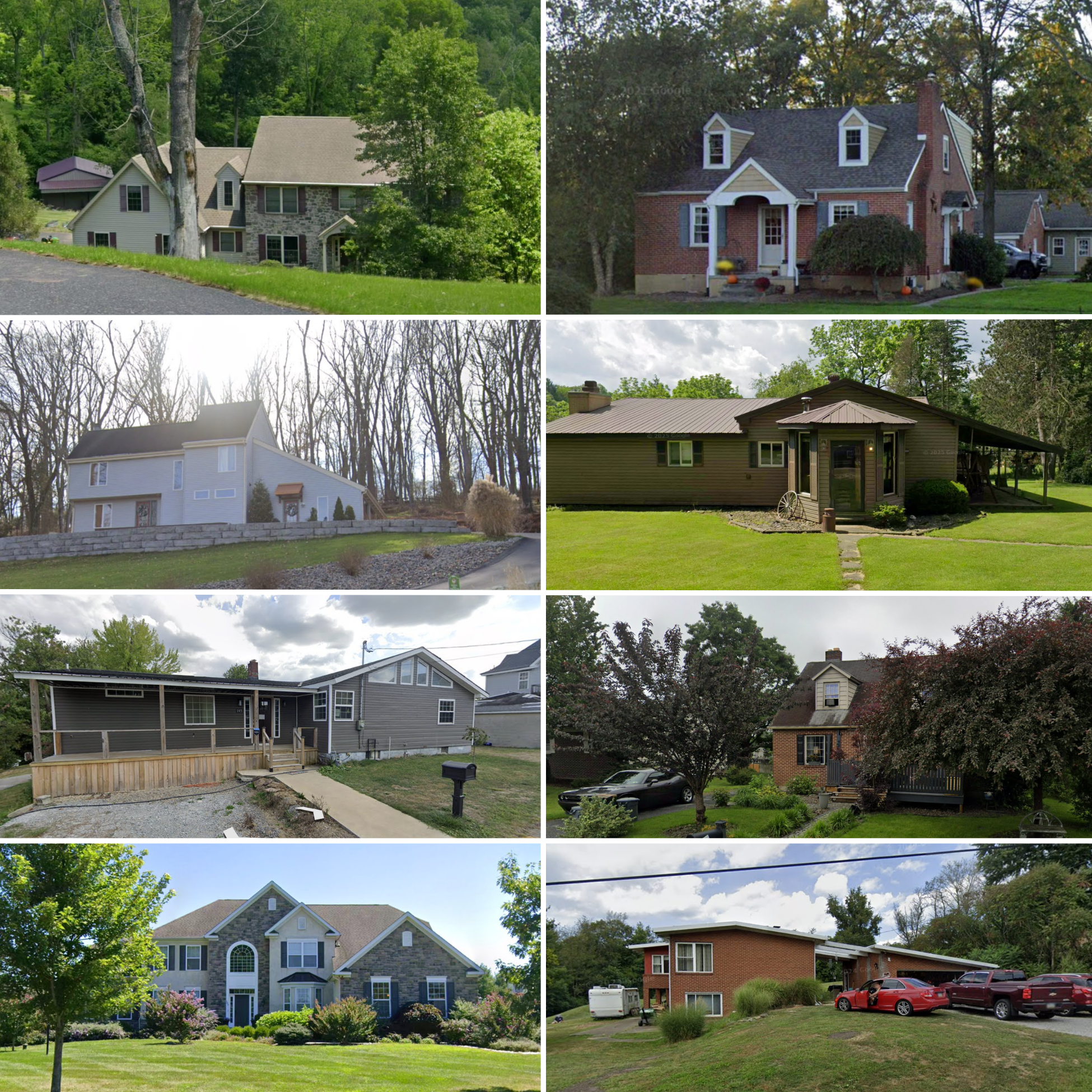
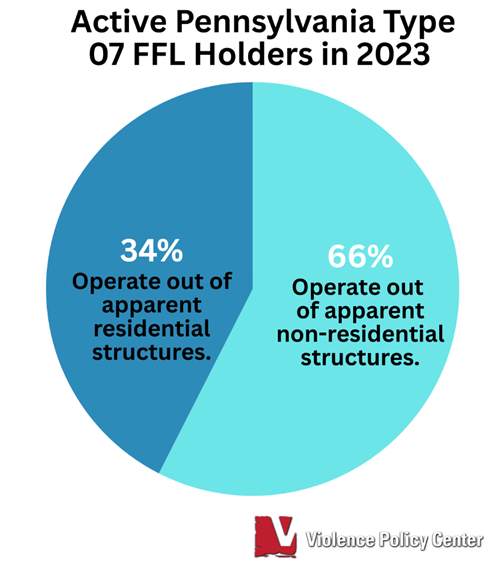
Altogether, 34 percent (44 of 129) of all Pennsylvania Type 07 license holders who reported manufacturing guns in 2023 appeared to be operating out of a residential structure.
Pennsylvania Regulations
As in other states, the first step to becoming a firearms manufacturer in Pennsylvania is to obtain a Type 07 Federal Firearms License (FFL). Federal law requires that applicants for any FFL must certify that their business will comply with all applicable state and local laws, and certify that:
The business to be conducted under the license is not prohibited by State or local law in the place where the licensed premise is located; within 30 days after the application is approved the business will comply with the requirements of State and local law applicable to the conduct of the business; and the business will not be conducted under the license until the requirements of State and local law applicable to the business have been met; and that the applicant has sent or delivered a form to be prescribed by the Attorney General, to the chief law enforcement officer of the locality in which the premises are located, which indicates that the applicant intends to apply for a Federal firearms
license.25
In addition to an FFL, a gun manufacturer must apply to the applicant’s local sheriff for a Pennsylvania License to Sell Firearms.26 The application process involves an in-person visit to the sheriff’s office.27 The Pennsylvania State Police review the information submitted by sheriff’s departments and issue the license.28
The business must also be registered with the Pennsylvania Department of State.29 Beginning in 2025, all business entities registered to do business in Pennsylvania must submit an annual registration report with the Pennsylvania Department of State. The penalties for failure to register include loss of permission to do business in the state and rights to the exclusive use of its business name. It could also lose its limited-liability status, meaning business owners could become personally liable for any potential lawsuits filed against the business.
For this report, the VPC utilized the Pennsylvania Department of State’s Business Entity Search database to identify Type 07 license holders that were registered as businesses with the state.30 As noted earlier in this report, there are 732 Pennsylvania Type 07 license holders listed on ATF’s final Federal Firearms Listings for 2023. These 732 license holders represent all Type 07 licensees in Pennsylvania for that period, whether they were manufacturing firearms or not. Of the 732 Type 07 FFL holders identified in 2023, the VPC found that 641 appeared to be registered and in good standing with the state as of February 2026. Of the remaining 91 Type 07 FFL holders, two were inactive/dissolved, and 89 were not found by the VPC in the Department of State’s database.31
Pennsylvania’s Uniform Firearms Act of 1995 preemption law prevents local governments, such as cities and townships, from passing their own gun ordinances stricter than state law.32 This state-wide preemption has faced recent constitutional challenges, most notably from Philadelphia.
In Crawford v. Commonwealth, the City of Philadelphia along with a gun violence prevention organization challenged the preemption law, arguing it violates fundamental rights and hinders local health and safety efforts. In November 2024, the Pennsylvania Supreme Court upheld the preemption law, finding it constitutional, despite acknowledging significant problems with gun violence.33
Nonetheless, local jurisdictions still retain some authority to regulate firearm manufacturers through local zoning restrictions. As the website FFL123 notes:
[W]hile most states have preemption laws about firearms ownership, they do not have a single statewide regulations governing zoning and business licensing. Local jurisdictions can and sometimes do use their zoning and business licensing powers to harass and even deny FFL holders the chance to setup [sic] shop and do business.
In Pennsylvania, Philadelphia is infamous among would be FFL holders for getting zoning approved. Without a specific variance, it is all but impossible to get approval in Philadelphia to have an FFL business. Not only does that destroy the chance for small, part time home based FFL holders to operate in Philadelphia, but it makes it extremely difficult for larger brick and mortar storefronts to open and operate. Your ATF examiner won’t be issuing you an FFL for Philadelphia until you show that you’ve acquired the needed variance to open your location.
In fact, zoning is the biggest problem any Pennsylvania FFL holder faces, regardless of where they live. While most places don’t make it hard to have a brick and mortar FFL, some jurisdictions may make it difficult to operate a small home-based business of any sort.
Home based FFL’s [sic] are often attacked by anti-gun groups, and are shrouded in all sorts of mythology and confusion. Some local authorities may think they are not Federally legal (which is not true!) or may try to impose requirements they aren’t allowed to under the law.34
The authority for localities to implement zoning restrictions for FFLs is limited, however. Pro-gun organizations challenged Lower Merion Township’s zoning regulations which included requirements on how the business must operate, such as specific security measures. A Pennsylvania court struck down the township’s zoning ordinance, finding that it violated the state’s preemption statute. The court, however, distinguished the township’s ordinance from a Philadelphia ordinance that was found not to be preempted because the Philadelphia ordinance regulated the location of firearm businesses and did not restrict how the business is conducted.35 Hence, local zoning ordinances that are limited to regulating the location of FFLs are permitted.
Litigation can also be an option for cities to regulate certain conduct by gun manufacturers. For example, the City of Philadelphia filed a lawsuit in July 2023 against JSD Supply and Polymer80, accusing them of fueling gun violence by selling components for untraceable “ghost guns.”36 In April 2024, a settlement was reached requiring JSD Supply, the largest distributor of ghost guns in Pennsylvania, to stop selling ghost gun kits to consumers in Pennsylvania for four years. Eagle Shows, a gun show operated by JSD Supply, agreed to prevent vendors from selling ghost guns at their events for two years.37
Is There a Gun Manufacturer Next Door to You?
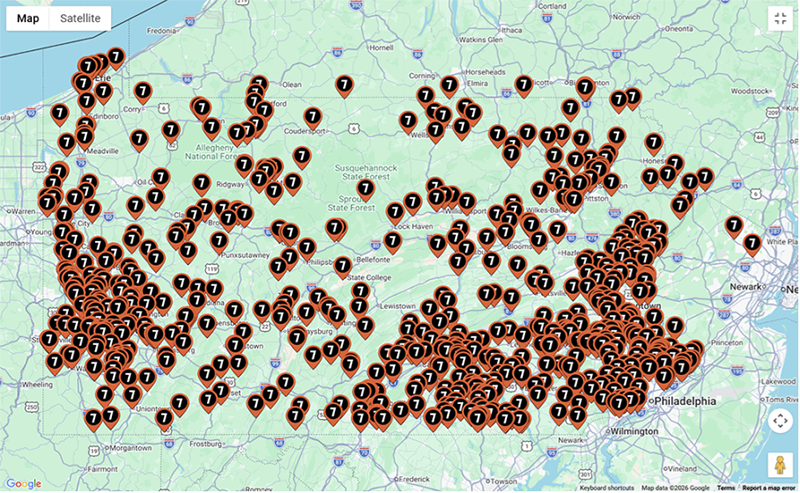
As noted earlier, in conjunction with its research on the illegitimate possession of Type 07 FFLs, the Violence Policy Center developed an online tool that allows the user to enter their home (or any) address to see if there are any Type 07 federally licensed gun manufacturers near them. The tool also allows the user to search for Type 01 gun dealer license holders. The tool can also be used to identify license holders by state or zip code. To access the online tool, please click on the graphic below.
Conclusion and Recommendations
The proliferation of Type 07 license holders who do not manufacture firearms raises serious public safety concerns. Our research reveals that a significant number (both nationally and in Pennsylvania) do not manufacture any firearms. This leads to the natural question: why do they possess the license? If history is any guide, one answer may be that a significant proportion of licensed manufacturers obtained the Type 07 license to exploit the privileges granted to licensees rather than to operate a legitimate business. While this alone is worthy of further investigation, the fact that a significant number of manufacturers are located in residential areas makes finding answers to this basic question imperative. Potential state and local recommendations that could be applied to Pennsylvania are listed below.
Recommendations
The primary recommendation stemming from this study’s findings is that the state and local communities should identify ways to confirm in an ongoing manner that license holders are currently obeying all state and local requirements. In addition to zoning, this would include the Pennsylvania License to Sell Firearms as well as business registration with the Pennsylvania Department of State.
In addition, research should be conducted examining the practice of Type 07 license holders with an SOT obtaining or building “dealer sample” machine guns for government agencies (for example, local law enforcement) when, in fact, the weapons are obtained/manufactured for personal use by the license holder.
In addition, general recommendations on the local, state, and federal levels are listed below.
General State and Local Recommendations
- All state and local jurisdictions should review FFL holders in their state/community to ensure that they are in compliance with all tax, zoning, business licensing laws, and other relevant regulations.
- All states, and where possible local jurisdictions, should implement new standards for manufacturers to decrease the number of Type 07 license holders who have obtained the license for personal use.
- All states should establish manufacturer licensing requirements, including the authority to routinely inspect license holders.
- For each state, a registry of Type 07 FFL holders should be available, preferably in map form, on local government websites to further inform the public of firearms manufacturing within residential and other sensitive areas.
Federal Recommendations
- The fees for a Type 07 manufacturer’s license should be increased significantly. The fees for the Special Occupancy Tax (SOT) should also be increased. The fees should also be indexed for inflation.
- Repeal the current restrictions limiting the Bureau of Alcohol, Tobacco, Firearms and Explosives (ATF) to one inspection in a 12-month period and allow ATF to conduct routine inspections of licensed manufacturers.
- The issuance of Type 07 manufacturers’ licenses should be restricted to entities with locations zoned for industrial activities. No licenses should be issued to persons operating from residential locations.
- Manufacturers should be required to routinely submit proof to federal, state, and local authorities demonstrating that the manufacturing facility is in compliance with all applicable zoning laws.
- ATF should ensure that all manufacturers are supplying accurate reports of firearm production and export.
Author and Acknowledgments
Copyright © May 2026 Violence Policy Center
The Violence Policy Center (VPC) is a national nonprofit educational organization that conducts research and public education on violence in America and provides information and analysis to policymakers, journalists, advocates, and the general public.
This study was funded with the support of The Joyce Foundation.
This study was authored by VPC Investigative Analyst Jamie Benedi. Additional research assistance was provided by VPC Senior Policy Analyst Marty Langley. The study was edited by VPC Executive Director Josh Sugarmann. For a complete list of VPC publications with document links, please visit https://www.vpc.org/publications/.
To learn more about the Violence Policy Center, please visit www.vpc.org.
To learn more about the Violence Policy Center’s Campaign for Gun Industry Accountability, please visit https://gunindustryaccountability.org/.
To make a tax-deductible contribution to help support our work, please visit https://www.vpc.org/contribute.
- Firearms Commerce in the United States: Annual Statistical Update 2021, Bureau of Alcohol, Tobacco, Firearms and Explosives, https://www.atf.gov/firearms/docs/report/2021-firearms-commerce-report/download; Federal Firearms Listings, Bureau of Alcohol, Tobacco, Firearms and Explosives, https://www.atf.gov/firearms/tools-and-services-firearms-industry/federal-firearms-listings.
- The most recent year for which both Type 07 license information and firearm production numbers were available at time of writing.
- See https://www.atf.gov/media/15716/download.
- Federal Firearms Listings, Bureau of Alcohol, Tobacco, Firearms and Explosives, https://www.atf.gov/firearms/tools-and-services-firearms-industry/federal-firearms-listings.
- The most recent year for which both Type 07 license information and firearm production numbers were available at time of writing.
- See https://www.atf.gov/media/15716/download.
- Federal Firearms Listings, Bureau of Alcohol, Tobacco, Firearms and Explosives, https://www.atf.gov/firearms/tools-and-services-firearms-industry/federal-firearms-listings.
- See Federal Firearms Listings, https://www.atf.gov/firearms/tools-and-services-firearms-industry/federal-firearms-listings.
- See Federal Firearms Listings, https://www.atf.gov/firearms/tools-and-services-firearms-industry/federal-firearms-listings.
- The current dramatic increase in Type 07 manufacturer license holders mirrors a similar increase in Type 01 dealer license holders that occurred at the end of the last century.
The 1992 Violence Policy Center study More Gun Dealers Than Gas Stations (https://vpc.org/wp-content/uploads/2020/03/More-Gun-Dealers-Than-Gas-Stations-1992.pdf) revealed that from 1975 to 1992 the number of Type 01 FFLs ballooned from 146,429 to 245,000 ─ an increase of 67 percent. The licenses were so easily obtained from ATF that at the time of the study’s release the number of Americans who possessed a Type 01 FFL was greater than the number of gas stations across the nation: 245,000 compared to 210,000. The bulk of the licenses were held by “kitchen-table” dealers. These license holders operated out of their homes or offices, as opposed to storefront gun dealers (commonly known as “stocking dealers”). Of these kitchen-table dealers, an unknown percentage were actively involved in criminal gun sales as well as illegal firearms trafficking.
In response to the widespread abuse of Type 01 FFLs and at the urging of the Violence Policy Center, the Clinton Administration began strictly enforcing the requirement that license holders be “engaged in the business” of selling firearms as required by federal statute. In addition, the 1994 Brady Law implemented many of the recommendations the VPC laid out in its 1992 study. Additional requirements were contained in the 1994 Violent Crime Control and Law Enforcement Act. Heightened ATF scrutiny, both at the time of issuance and renewal, sent a message to the firearms community (both law-abiding and criminal) that the days when a dealer’s license could be obtained with virtually unquestioned ease had come to an end. At the same time, state and local jurisdictions began focusing on kitchen-table dealers via a wide range of enforcement mechanisms (e.g., instituting their own standards for license eligibility, enforcing zoning and business laws, and conducting onsite inspections of licensees’ “place of business”). As a result of this range of enforcement efforts, the number of Type 01 FFLs in the United States has dropped 78 percent ─ from 213,734 in 1994 to 47,267 in 2024. In 2024, the Biden Administration implemented a rule to force more people to obtain gun dealer licenses. The measure was intended to enhance safety, yet the question remained whether the unintended consequence would be a return to the days when there were more gun dealers than gas stations and corrupt gun dealers were associated with a high volume of illegally trafficked firearms. In April 2025, under the Trump Administration, the Department of Justice and the Bureau of Alcohol, Tobacco, Firearms and Explosives announced a review of “Final Rule 2022R-17F, related to the definition of ‘engaging in the business’ of firearms dealing.”
- The term “engaged in the business” means “a person who devotes time, attention, and labor to manufacturing firearms as a regular course of trade or business with the principal objective of livelihood and profit through the sale or distribution of the firearms manufactured.” 18 USC § 921(a)(21).
- 18 USC § 922 (a)(1).
- 26 USC §5845(f) defines the term “destructive device” as “(1) any explosive, incendiary, or poison gas (A) bomb, (B) grenade, (C) rocket having a propellent charge of more than four ounces, (D) missile having an explosive or incendiary charge of more than one-quarter ounce, (E) mine, or (F) similar device; (2) any type of weapon by whatever name known which will, or which may be readily converted to, expel a projectile by the action of an explosive or other propellant, the barrel or barrels of which have a bore of more than one-half inch in diameter, except a shotgun or shotgun shell which the Secretary finds is generally recognized as particularly suitable for sporting purposes; and (3) any combination of parts either designed or intended for use in converting any device into a destructive device as defined in subparagraphs (1) and (2) and from which a destructive device may be readily assembled.”
- See https://www.ffl123.com/.
- See FFL & Class 3 License Guides, FFL123, downloaded May 2023, in files of Violence Policy Center.
- An applicant/license holder can qualify for a “reduced” rate of $500 per year if the license holder’s total income (“not just receipts relating to the activity subject to special occupational tax”) for the tax year is less than $500,000.
- “Special Tax Registration and Return National,” Bureau of Alcohol, Tobacco, Firearms and Explosives, https://www.atf.gov/firearms/docs/form/special-tax-registration-and-return-national-firearms-act-atf-form-56307/download.
- “The Ultimate Guide to SOT,” FFL123 blog, November 24, 2021, https://www.ffl123.com/the-ultimate-guide-to-sot/#Class_1_SOTs.
- “Who Can Own a Full-Auto Machine Gun?,” FFL123 blog, July 2, 2021, https://www.ffl123.com/who-can-own-a-full-auto-machine-gun/.
- FFL & Class 3 License Guides, FFL123, downloaded May 2023, in files of Violence Policy Center.
- Firearms Compliance Inspection Results: Monthly Data, Bureau of Alcohol, Tobacco, Firearms, and Explosives, last review date of August 9, 2025, https://www.atf.gov/firearms/firearms-compliance-inspection-results; Report of Active Firearms Licenses — License Type by State Statistics, Bureau of Alcohol, Tobacco, Firearms, and Explosives, December 10, 2024, https://www.atf.gov/sites/default/files2/ffl/1224-ffl-list.csv.
- Firearms Compliance Inspection Results: Monthly Data, Bureau of Alcohol, Tobacco, Firearms and Explosives, last review date of April 9, 2025, https://www.atf.gov/firearms/firearms-compliance-inspection-results.
- FY 2026 Budget and Performance Summary, U.S. Department of Justice, https://www.justice.gov/media/1403736/dl.
- Fact Sheet ─ Facts and Figures for Fiscal Year 2024, Bureau of Alcohol, Tobacco, Firearms, and Explosives https://www.atf.gov/resource-center/fact-sheet/fact-sheet-facts-and-figures-fiscal-year-2024.
- 18 USC § 923(d)(1)(F).
- See https://www.pacodeandbulletin.gov/Display/pacode?file=/secure/pacode/data/037/chapter33/s33.117.html&d=reduce. For an example of the application see https://centrecountypa.gov/DocumentCenter/View/25662/Application-for-a-Pennsylvania-License-to-Sell-Firearms—SP-4-128-4-2019-FILLABLE.
- See https://centrecountypa.gov/2057/License-to-Sell-Firearms; https://yorkcountypa.gov/1010/License-to-Sell.
- See https://www.pa.gov/agencies/psp/programs/firearms/firearms-information#accordion-8532a45748-item-a309c06f4b.
- See https://business.pa.gov/register/.
- See https://file.dos.pa.gov/search/business
- See https://file.dos.pa.gov/search/business
- 18 Pa.C.S. § 6120.
- Crawford v. Commonwealth, 326 A.3d 850.
- See https://www.ffl123.com/how-to-get-ffl-in-pennsylvania/?srsltid=AfmBOorlYlcM15elWJqAn8A7TIGo3-5_MSi_iW1dFefy_oicbLGZs1YG.
- Firearm Owners Against Crime-Institute for Legis. & Legal Educ. Action v. Lower Merion Twp., 2025 Pa. Commw. LEXIS 175.
- See https://files.giffords.org/wp-content/uploads/2024/04/Giffords-Law-Center-Philadelphia-Ghost-Guns-Lawsuit-Complaint-2023.07.05.pdf.
- See https://www.phila.gov/2024-04-12-city-of-philadelphia-announces-settlement-agreement-in-lawsuit-against-primary-distributors-of-ghost-guns-polymer80-inc-and-jsd-supply/.